
22 Different Dashboard Warning Lights of Car Explained
Every time you turn on your car, a series of lights briefly flash across your dashboard. This is your vehicle running a quick self-check; ensuring every system is ready to go. Most lights turn off within a few seconds. But when one stays on, or a new one appears while you’re driving, your car is sending you a message.
Ignoring a warning light is one of the most common and costly mistakes drivers make. For high-performance and luxury vehicles, where engines operate under tight tolerances and advanced electronics manage every system, ignoring a light can be catastrophic. What starts as a minor issue can quickly turn into a major repair, or worse, put you in danger on the road. This guide explains every important warning light in simple terms, so you always know when to act fast and when you can wait a little.
We’ve organised lights by urgency, starting with the most serious. Understanding even the basics could save your engine, your wallet, and your safety.
Not sure what that light means? ARMotors provides factory-grade diagnostics for all luxury car brands across Dubai and the UAE. Book a same-day diagnostic check today. |
Critical Warning Lights — Stop Driving
These lights mean something is seriously wrong. Pull over safely and do not continue driving until the issue is resolved.
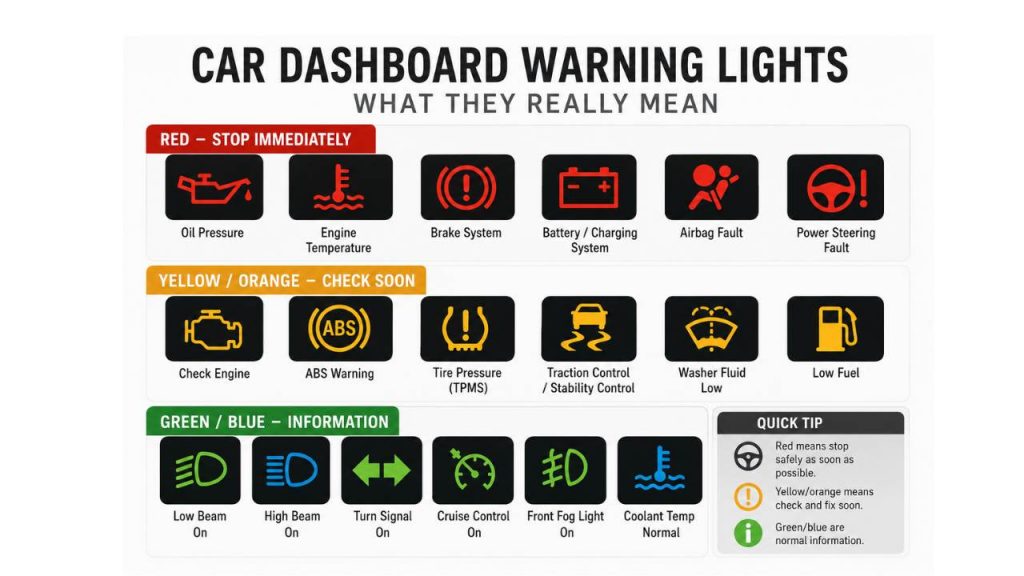
1. Check Engine Light
Severity: Critical — Do Not Ignore
What it looks like: A silhouette of an engine, or a text warning (like Engine Control Fault) on your digital instrument cluster.
What it means: Your car has detected a problem in its engine or emissions system. This light is intentionally vague, it covers hundreds of possible issues. It could be something minor like a loose gas cap, or something serious like an engine misfire or a faulty oxygen sensor.
What you should do: If the light is steady (not flashing) and your car drives normally, don’t panic, but do get it checked within a day or two. A mechanic will plug in a diagnostic scanner to read the exact fault code and pinpoint the cause.
If the light is flashing or blinking, this is urgent. Pull over safely as soon as possible and call for assistance. A blinking check engine light usually means the engine is misfiring, which can cause permanent engine damage if you keep driving.
- Common causes: Loose gas cap, faulty sensor, emission issue, worn spark plugs
- Can you drive? Steady light: short trips only. Flashing light: stop immediately
- Urgency: Get a diagnostic scan as soon as possible
2. Oil Pressure Warning
Severity: Critical — Stop the Car
What it looks like: An old-fashioned oil can with a small drop of oil falling from it.
What it means: Your engine oil pressure has dropped dangerously low. Oil is the lifeblood of your engine, it lubricates hundreds of moving parts and prevents them from grinding against each other. Without proper oil pressure, your engine can seize up in minutes.
What you should do: Pull over safely and turn off the engine immediately. Check your oil level using the dipstick under the bonnet. If it’s low, carefully add the correct oil type for your car. Restart and see if the light goes off.
If the light stays on after adding oil, or comes back quickly, do not drive the car. Call a mechanic. Continuing to drive with this light on is one of the fastest ways to completely destroy an engine.
- Common causes: Low oil level, oil leak, broken oil pump, worn engine parts
- Can you drive? Stop immediately and turn off the engine
- Urgency: Extremely high, minutes matter
3. Coolant Temperature Warning
Severity: Critical — Engine Overheating
What it looks like: A thermometer dipping into wavy water lines.
What it means: Your engine is overheating. Coolant (also called antifreeze) circulates through your engine to keep it from getting too hot. When this light comes on, your cooling system is failing, and an overheated engine can warp, crack, or be permanently destroyed.
What you should do: Turn off the air conditioning immediately (it adds load to the engine) and turn the heater on full blast. This sounds strange, but it helps pull heat away from the engine. If the temperature gauge keeps rising, pull over safely and turn off the engine.
Do not open the bonnet immediately, wait at least 30 minutes for the engine to cool before checking coolant levels. Never remove the coolant cap while the engine is hot.
- Common causes: Low coolant, broken water pump, burst hose, damaged radiator
- Can you drive? Stop driving and let the engine cool down
- Urgency: Very high, engine damage can occur within minutes
4. Brake System Warning
Severity: Critical — Safety Risk
What it looks like: An exclamation mark inside a circle, sometimes with the letter “P” or the word “BRAKE”.
What it means: Something is wrong with your braking system. This is one of the most safety-critical lights on your dashboard. The most common, and harmless, cause is forgetting to release the handbrake before driving. But if the handbrake is down and the light is still on, it could mean worn brake pads, low brake fluid, or a fault in the anti-lock braking system (ABS).
What you should do: First, check your handbrake is fully released. If the light remains, test your brakes gently, if they feel spongy, unresponsive, or the car pulls to one side when braking, stop driving immediately. If the brakes feel completely normal, drive carefully to a workshop that same day.
- Common causes: Handbrake on, worn brake pads, low brake fluid, ABS fault
- Can you drive? Only if brakes feel completely normal, visit a workshop the same day
- Urgency: High, get it checked immediately
Urgent Warning Lights — Act Soon
These lights don’t require you to stop immediately, but you should see a mechanic within 24–48 hours.
5. Battery Warning
Severity: Urgent — Get Checked Soon
What it looks like: A simple rectangle with a plus (+) and minus (−) symbol; exactly what a battery looks like.
What it means: Your car’s electrical charging system isn’t working properly. This could be the battery itself losing its ability to hold a charge, a failing alternator (the part that recharges the battery while you drive), or a wiring issue. The tricky part is your car may start and drive perfectly fine right now, but could suddenly refuse to start later.
What you should do: Don’t turn off the engine if you can avoid it, as the car may not restart. Drive straight to a mechanic or battery shop. Avoid using heavy electrical features like air conditioning, heated seats, or charging ports, as these drain the battery faster.
- Common causes: Old battery, faulty alternator, loose or corroded battery terminals
- Can you drive? Yes, but go straight to a mechanic, try not to turn the engine off
- Urgency: High, within the same day
6. Tire Pressure Warning (TPMS)
Severity: Urgent — Check Tires Now
What it looks like: A horseshoe shape (like a flat tire cross-section) with an exclamation mark in the middle and small lines at the bottom representing tire tread.
What it means: One or more of your tires is significantly under-inflated (or sometimes over-inflated). Driving on flat or very low tires is dangerous, it affects steering and braking, and can cause a blowout at high speed. In hot climates like Dubai, tire pressure changes are more common due to extreme temperatures.
What you should do: Pull over somewhere safe and visually inspect all four tires. Many modern cars show the exact pressure of each tire on the dashboard or infotainment menu, check which tire is low. Use a petrol station air pump to inflate to the correct pressure (usually printed on a sticker inside your driver’s door). After driving a few minutes, the light should go off. If it doesn’t, the tire may have a slow puncture and needs a professional check.
- Common causes: Natural air loss, temperature changes, puncture or nail in the tire
- Can you drive? Only slowly to the nearest petrol station, avoid motorway speeds
- Urgency: High, stop and check within minutes
7. Airbag Warning
Severity: Urgent — Safety System Fault
What it looks like: A person sitting in a seat with a large circle in front of them, representing an inflated airbag.
What it means: There is a fault with one or more of your car’s airbags. This won’t affect your normal driving, but if you were in an accident, your airbags might not deploy, which could be life-threatening. In rare cases, a faulty airbag could also accidentally deploy while driving.
What you should do: The car is safe to drive in terms of normal performance, but book a workshop visit within 24–48 hours. Do not attempt to service the airbag system yourself, airbags contain explosive charges and must only be handled by trained technicians.
- Common causes: Faulty sensor, damaged airbag clockspring, wiring issue
- Can you drive? Yes, but get it fixed within 1–2 days
- Urgency: Moderate-high, affects your safety in an accident
8. Transmission Temperature Warning
Severity: Urgent — Gearbox Overheating
What it looks like: A thermometer inside a gear or cog shape.
What it means: This is most common during heavy towing, stop-start Dubai traffic, or when transmission fluid is low. Advanced dual-clutch transmissions (DCT/PDK) found in sports cars are highly sensitive to thermal limits; ignoring this warning can result in some of the most expensive component failures in automotive maintenance.
What you should do: If you’re towing something, stop and let the vehicle cool. Avoid heavy acceleration. Drive to a workshop as soon as possible. Don’t ignore this light, transmission repairs are among the most expensive fixes in automotive maintenance.
- Common causes: Low transmission fluid, heavy towing, excessive stop-start driving
- Can you drive? Drive gently to a workshop, avoid motorways
- Urgency: High, transmission repairs are very costly if ignored
Informational & System Lights, Monitor
These lights are usually just letting you know about a system status. Many are informational, not signs of danger.
9. Traction / Stability Control
Activates automatically when your wheels slip on wet or slippery roads, this is normal. If it stays on permanently on dry roads, a sensor may be faulty. In sports cars, this light flashes when the vehicle’s electronic stability management steps in to correct traction during hard acceleration or cornering. Visit a workshop if it doesn’t go off on its own.
10. Low Fuel
You’re running low on petrol or diesel. The small arrow next to the fuel pump icon tells you which side of the car the fuel cap is on. Stop at the nearest petrol station soon.
11. Low Washer Fluid
Your windscreen washer reservoir is empty. Top up with screen wash fluid from any petrol station or auto shop. Not urgent, but useful, especially on dusty UAE roads.
12. Door Open
One of your doors, the boot, or the bonnet isn’t properly closed. Stop safely and check all doors. Push each one firmly until you hear a click.
13. Seatbelt Reminder
Someone in the car hasn’t fastened their seatbelt. Ensure all passengers are buckled up. If the light stays on after buckling, have the sensor checked.
14. Lane-Keep Assist Off
Your lane-keeping system has been switched off or is temporarily unavailable (for example, due to faded road markings). No action needed unless you want to re-enable it in your car’s settings.
15. Automatic Emergency Braking (AEB) Disabled
Your automatic emergency braking system is temporarily unavailable, often caused by a dirty sensor or camera in dusty or rainy conditions. Clean your front camera and radar sensor. High-end vehicles rely heavily on radar and camera grids behind the windscreen or front grille. Fine desert dust or film buildup on these lenses will frequently deactivate these safety systems until cleaned. If the light stays on, visit a workshop.
16. Immobiliser Warning
Your car’s anti-theft immobiliser is active and may not be recognising your key or fob. Try a different key. If using a card key, place it in the designated spot described in your owner’s manual.
17. Auto Stop-Start Active
Your engine has turned off automatically at a red light to save fuel. This is completely normal and intentional. Press the accelerator to restart, no action needed.
18. Charging Cable Connected (EV / Plug-in Hybrid)
Your electric or plug-in hybrid vehicle is connected to a charging cable. Unplug it before driving. The car will not move while still connected.
19. Headlights On
Your headlights are currently switched on. No action needed, this simply confirms your exterior lights are active.
20. High-Beam Active
Your high-beam (full-beam) headlights are on. These can blind oncoming drivers. Switch to low beams when other cars are nearby, and use high beams only on dark, empty roads.
21. Lamp Out
One of your external bulbs has blown, a headlight, taillight, or indicator. Identify which bulb is out and replace it. Driving with a blown headlight or taillight is illegal in the UAE.
22. Freezing Temperature Alert
The outside temperature has dropped close to freezing. Roads may be icy. This is an advisory alert, not a mechanical fault, drive cautiously. Rarely relevant in Dubai, but may appear if you’re driving in the UAE mountains.
The Dashboard Traffic Light System: At a Glance
Individual symbols give you the easiest way to gauge urgency is by looking at the colour of the illuminated light.
Light Color | Risk Level | Action Required |
🔴 Red | Critical Emergency | Pull over safely, stop the engine immediately, and arrange a recovery truck. |
🟡 Amber / Yellow | Urgent Warning | System fault detected. Book a diagnostic check within 24–48 hours. |
🟢 Green / 🔵 Blue | Informational | System active status confirmation (e.g., High-beams, Cruise Control). No action needed. |
Final Thoughts: Listen to Your Car
Your dashboard is your car’s way of speaking to you. The good news is that most warning lights have a straightforward fix, especially when caught early. The danger comes from ignoring them and hoping they’ll go away on their own. They rarely do.
A few golden rules to remember:
- Red lights are emergencies. Stop driving and investigate immediately.
- Amber lights are urgent. Book a mechanic visit within 24–48 hours.
- Green and blue lights are usually just confirming a system is active, no need to worry.
And if you’re in Dubai or anywhere in the UAE, the team at ARMotors is always here. Our workshop is fully equipped with factory-grade diagnostic software specifically for high-end European marques, ensuring your vehicle receives the precise care it requires. Book your diagnostic check with our specialists today.