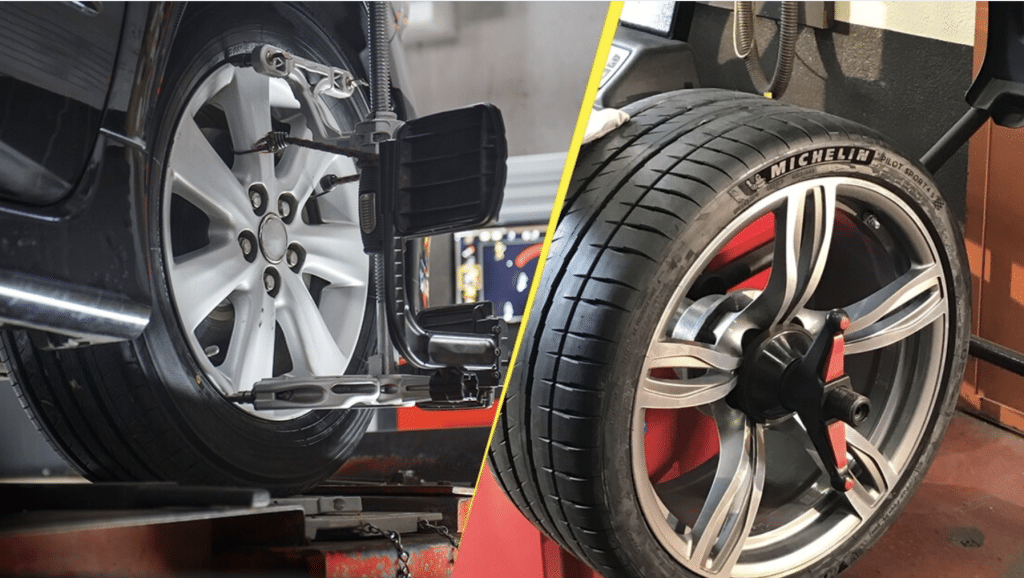

If you’ve ever been told your car needs a wheel alignment or tyre balancing, you may have wondered whether they’re the same thing. While both services help improve your vehicle’s handling, safety and tyre lifespan, they solve very different problems.
Understanding the difference between wheel alignment vs tyre balancing can help you avoid premature tyre wear, improve driving comfort and even save money on unnecessary tyre replacements especially in the UAE, where high temperatures, potholes, speed bumps and long motorway drives can take a toll on your vehicle.
What is Wheel Alignment?
Wheel alignment refers to adjusting your vehicle’s suspension angles so that all four wheels are correctly positioned according to the manufacturer’s specifications. Contrary to its name, wheel alignment doesn’t actually adjust the wheels themselves – it fine-tunes the suspension geometry.
Proper alignment ensures your tyres make even contact with the road, allowing your vehicle to drive straight and handle as intended.
Signs You Need a Wheel Alignment
- Vehicle pulls to one side while driving
- Steering wheel is off-centre when driving straight
- Uneven or rapid tyre wear
- Poor steering response
- Squealing tyres during turns
- Reduced fuel efficiency
In the UAE, driving over speed bumps, potholes, kerbs or road debris can gradually knock your alignment out of specification.
What is Tyre Balancing?
Tyre balancing involves evenly distributing the weight of the tyre and wheel assembly. Even a brand-new tyre can have slight weight variations that create vibrations if not properly balanced.
Technicians use specialised balancing equipment to identify heavier areas of the wheel before attaching small balancing weights to achieve perfect rotation.
Signs Your Tyres Need Balancing
- Steering wheel vibration at certain speeds
- Vibrations felt through the seats or floor
- Uneven tyre wear
- Increased road noise
- Reduced ride comfort
Unlike wheel alignment, tyre balancing is focused on eliminating vibration rather than correcting steering geometry.
Wheel Alignment vs Tyre Balancing: The Key Differences
Wheel Alignment | Tyre Balancing |
Adjusts suspension angles | Balances tyre and wheel weight |
Corrects steering issues | Eliminates vibrations |
Prevents uneven tyre wear | Prevents vibration-related wear |
Improves handling and stability | Improves ride comfort |
Recommended after suspension work or impacts | Recommended whenever tyres are fitted or rotated |
Although they’re different services, they’re often performed together for optimal performance.
Can You Need Both?
Yes. In fact, many vehicles benefit from both services at the same time.
For example:
- You replace all four tyres – balancing is essential, alignment is recommended.
- You hit a pothole or kerb – alignment may be affected, and balancing should be checked if the wheel has been damaged.
- Your steering wheel vibrates and your tyres are wearing unevenly – both services may be required.
A professional inspection can quickly determine which service your vehicle needs.
Why These Services Matter in the UAE
Driving conditions in Dubai and across the UAE place additional stress on your tyres and suspension.
Factors include:
- Extreme summer temperatures
- Long motorway journeys
- Frequent speed bumps
- Road construction zones
- Occasional potholes and uneven road surfaces
Even minor impacts can gradually affect your alignment, while everyday driving naturally changes tyre balance over time.
Regular maintenance helps maximise tyre life and keeps your vehicle performing safely and efficiently.
Benefits of Proper Wheel Alignment and Tyre Balancing
Keeping your wheels correctly aligned and balanced offers several advantages:
- Longer tyre lifespan
- Improved fuel efficiency
- Better steering precision
- Enhanced driving comfort
- Reduced suspension wear
- Increased road safety
- Smoother motorway driving
- Lower long-term maintenance costs
For luxury and performance vehicles, maintaining precise wheel geometry is particularly important to preserve the handling characteristics engineered by the manufacturer.
How Often Should They Be Checked?
As a general guide:
Wheel Alignment
- Every 10,000–15,000 km
- After hitting a pothole or kerb
- Following suspension or steering repairs
- When fitting new tyres
- If you notice uneven tyre wear
Tyre Balancing
- Whenever new tyres are installed
- During tyre rotation
- After repairing a puncture
- If vibrations develop while driving
- Every 10,000–15,000 km as part of routine maintenance
Following your vehicle manufacturer’s maintenance schedule is always recommended.
Don’t Ignore the Warning Signs
Many drivers continue driving with poor alignment or unbalanced tyres because the symptoms seem minor at first. However, delaying repairs can lead to:
- Premature tyre replacement
- Increased suspension wear
- Reduced braking performance
- Poor vehicle handling
- Higher fuel consumption
Addressing these issues early is far more cost-effective than replacing tyres that have worn out prematurely.
Professional Wheel Alignment and Tyre Balancing at Alex Renner Motors
At Alex Renner Motors, our experienced technicians use precision equipment to accurately diagnose and correct wheel alignment and tyre balancing issues on luxury, sports and everyday vehicles. Whether you’ve noticed uneven tyre wear, steering vibration or simply want to maximise the life of your tyres, our team can ensure your vehicle delivers the smooth, confident drive it was designed for.
The Low Down
While wheel alignment and tyre balancing are often confused, they serve two distinct purposes. Wheel alignment ensures your vehicle tracks straight and your tyres wear evenly, while tyre balancing eliminates vibrations for a smoother, more comfortable drive.
Regularly checking both is one of the simplest ways to improve safety, extend tyre life and maintain your vehicle’s performance, particularly in the demanding driving conditions of the UAE.